Chili season is on — the dumps are back. Hand-blended in Fort Worth, Texas.
Since 1921 · Five generations

Cogdell in Commerce

A history of sales & customer service

I realize you didn’t come here to read about my family tree. Understanding that risk, I still wanted to remember them here by documenting not only their contributions in COMMERCE, but to FAMILY as well. From today’s Cogdell Kitchens, I have plans to feature each of their names on a future product — something that was in the kitchen or on the table at our family gatherings. While “Jeb’s 5th Wheel Chili Dump” kicks off a rebirth of sorts for the Cogdell name in commerce, it is but a by-product of those who came before me, and alongside me. It has been a real pleasure to sit down and document what came before us.

Robert Reid Cogdell
Some material paraphrased from The Black and White Lion by Lyn Jank (1977), and from the research and writings of Randall Scott of Waco.

Robert Reid Cogdell

“Bob”

R.R. “Bob” Cogdell, my great-grandfather… the man who started it all. Around 1919, Bob had a great idea after helping a stranded motorist in the countryside with a flat tire by offering up his own spare. Inspired by that event, the wheels in his head started turning, and later that year in Fort Worth, at 35 years of age, he invented and developed what would be called “Cogdell’s Lock-Fast Cold Patch” — a patch designed to quickly adhere to automobile tire tubes and fix a flat on the go. He worked initially from his $5-a-month rental home’s garage, selling out of his Ford truck called “Congress” (because it could not, or would not, pass anything). He began selling shop to shop. Demand quickly outstripped his production capabilities. My father once credited Mr. Cogdell with inventing the “six-pack,” as that was one way he tried to meet soaring demand for his patch — selling a 6-pack as the minimum purchase quantity. It wasn’t long before business was good enough to warrant the opening of Cogdell Auto Supply at 300 Calhoun St in downtown Fort Worth, where one of the Bass office towers stands today.

In 1932, Cogdell’s expanded to Waco, buying the liquidated Herrick Hardware Store on North 6th St, also known as Cogdell Auto Supply. They sold automotive parts and accessories, both wholesale and retail, along with hardware, radios, refrigerators, china, and household utensils. In the beginning, Leo H. Bradshaw Sr., Bob’s son-in-law, was the cashier; B.G. Thigpen was manager of the hardware department; Wilma Fowler was the manager of the glass and china department; and Robert Grogan was the shipping and receiving clerk.

The company continued to expand until October of 1934, when Cogdell Auto Supply moved to the 800 block of Austin Avenue and carried every household item “from wastebasket to cookstove,” as they would say in their frequent newspaper advertisements.

R.R. “Bob” Cogdell died in September, 1946.

Rezi Jarvis Covington Cogdell

Rezi Jarvis Covington Cogdell

“Ahoo”

My great-grandmother, who we simply called “Ahoo.” Married to Bob Cogdell and a lifelong supporter of his entrepreneurial spirit and endeavors. She lived on Bellaire Dr across from the TCU campus until her death in 1977. Of the handful of vague memories that I have of her as a young boy, her ’62 Cadillac Sedan DeVille is among the most prominent. She passed away in Fort Worth in 1977, when I was 11 years old.

Leo Herman Bradshaw Sr.

Leo Herman Bradshaw Sr.

“PaPa”

My grandfather “PaPa,” who continued to operate the Cogdell ventures from Waco. An avid outdoorsman, Leo enjoyed any opportunity to be hunting — from dove hunts in Bosque County with the legendary Texas game warden Harley Berg, to chasing trophy whitetail in South Texas on the Light Ranch with George Light II, to “big game” hunts in Alaska for weeks at a time. Leo was always appreciative of his favorite pastime and the wonderful meat it would provide for months at a time.

The son-in-law of Bob Cogdell, Leo not only took over the day-to-day operations of the Cogdell ventures — he took them to an exciting new level, both in product offering and profitability.

In 1948, the company moved the Cogdell Auto Supply Department to 1004 Franklin, where it operated for nearly the rest of the 20th century. In the years that followed, Cogdell’s moved from downtown Waco to their new, modern 18,000-square-foot store on Highway 6 (Valley Mills Drive close to New Road), and not long after added a 4,500-square-foot furniture display area. To the delight of many men and husbands who could quickly become bored while their mother or spouse shopped for furniture, china, silverware, and the like, Cogdell’s opened the “Field and Stream Room.” Using 1,800 square feet in the back of the building, a treasure trove of nationally known lines of hunting, fishing, and camping equipment stocked the shelves and displays. It would soon become THE place to purchase new and pre-owned firearms, optics and accessories, ammunition, skeet throwers, clay pigeons, and of course — the ever-important hunting and fishing license!

Leo was very active in the community, both in commerce and philanthropic causes. He would serve as Mayor of Waco in 1952. In 1956, Cogdell’s added a 5,500-square-foot warehouse and shop area to the store and broke ground on a $250,000 addition as more units were added to Cogdell’s Suburban Center. An additional store was opened in 1959 on 19th and Park Lake Drive; that store remained open until about 1968.

Leo passed away in 1972 following a battle with cancer.

Eleanor Rose Cogdell Bradshaw

Eleanor Rose Cogdell Bradshaw

“Sugie”

My grandmother, known to us grandkids as “Sugie.” Most of my memories of Sugie revolve around their grand old home on Hillcrest in Waco. Today, that home is known as the “Hillcrest Estate” and is owned and operated as a bed & breakfast by Magnolia’s own Chip and Joanna Gaines. Other visits included family getaways to the family farm just outside Cranfills Gap in Bosque County. Our Waco visits typically revolved around Christmas and Thanksgiving festivities, while trips to the farm always included the opening day of dove season, among other special times. You never had to wonder if game warden Harley Berg would show up on the farm, as he was almost always a guest of Leo’s, hunting out in the sunflower and sorghum fields with his favorite .410 shotgun. Never wanting to waste a shot, Harley was famous for taking his limit of dove using never more shells than the number of dove killed. He was an incredible marksman and a legendary Texas character.

Whether at the farm or the house in Waco, I remember the ever-present aroma of PaPa and Sugie’s cooking filling the air. They were both wonderful cooks — Leo displaying his skills over an open fire, grill, or smokehouse; Sugie displaying hers with more traditional cuisine in the kitchen. I have vivid memories of the beautiful glass bottles and mason jars filled with all kinds of peppered and pickled goodness, most of it straight from the farm’s garden. Pepper sauce for beans and black-eyed peas. Jalapeños to accompany meals of all kinds. Another favorite was Leo’s “red pepper and garlic dilled green tomatoes.” Sugie thought it was a great idea to share that recipe with the church cookbook the ladies published each year. Leo was not happy. That recipe can be found in “What’s Cooking in Cogdell Kitchens,” Volume III — and helped me name this 21st-century venture to carry on some family entrepreneurial spirit.

Leo H. Bradshaw Jr.

Leo H. Bradshaw Jr.

“Uncle Leo”

Leo Jr. essentially continued to run Cogdell’s Westview in Waco following my grandfather’s death. In 1982 they closed the doors; in 1983 “The Sportster” moved into the front of the building formerly occupied by Cogdell’s, and in 1989 “The Sports Spectrum” opened in that same building. All the while, Leo Bradshaw Jr. continued to sell guns in the back of the building until 2003, when he relocated his gun business to 1001 Wooded Acres Drive. His shop got a little smaller, but the flow of customers — both old-time “spit & whittle” members and new faces — kept coming. Leo truly had an encyclopedia-like knowledge of all things guns. While his favorites were vintage Colt revolvers and Winchester rifles, his knowledge ran WIDE and DEEP on just about any firearm you could think of. It wasn’t unusual for Leo to go beyond answering your gun-related questions: he’d answer in great detail, sure, but he never missed an opportunity to share an old story from personal recollection that went along nicely with the firearm in question — and he never missed an opportunity to make his knowledge and pontifications known to a greater audience than just you. Leo wasn’t just a loud talker; he wanted to be sure everyone in the shop could hear what he had to say.

After my father Jim Bradshaw passed away in 2009, my stops in Waco to see Leo became even more meaningful. I rarely missed an opportunity to stop by while en route home from Austin, Houston, or the coast. Always a meaningful detour. In 2013, I had the idea of doing a podcast with Leo to capture what I could of that encyclopedia-like knowledge. It was called “Gunpoint Cogdell.” Of course, I had BIG plans for it all, but my real job and life just kind of “got in the way.” I was, however, able to record seven episodes, and I still have them today. You can have a listen to them all here.

Leo Bradshaw Jr. continued in the gun business, operating Bradshaw/Cogdell’s Gun Shop until his death on March 9, 2019.

James E. “Jim” Bradshaw

James E. “Jim” Bradshaw

My late father — “Dad” & “PaPa”

My father, Jim Bradshaw. My hero. Growing up in Waco through high school, “Pee Wee,” as his father called him, had to grow up fast after beating polio as a child. Like his brothers, he left home for military school at Kemper Military Academy in Boonville, Missouri. He would later attend North Texas, where he was a Sigma Nu, and the University of Colorado, before finishing back in Waco at Baylor. Baylor is where he would find his “Baylor Beauty,” Ouida Pearl Massey from Memphis, Texas — the “May Queen.” They met on campus in 1961, married not long after, and he began his lifelong career in sales: first as a manufacturer’s rep out of Houston with Leo Kennedy Company, then on to Beaverton, Oregon, with Federal-Mogul, before finally joining the family in the automotive wholesale business with Cogdell Auto Supply in Fort Worth.

At the time, there was the Waco warehouse operation and the Fort Worth operation at 300 Calhoun downtown — where one of the Bass Towers stands today. As my grandfather was set to close the Fort Worth operation, my father asked him for the chance to move there and turn things around. Not only did he turn the business around, it flourished to the point of needing to expand. Soon the Fort Worth operation would break ground on Northpark Dr on the north side of Fort Worth for a 28,000-square-foot sprinkled tilt-wall warehouse (today housing Eubank’s Roofing). Together with the Waco warehouse, Cogdell Auto Supply would grow into one of the premier automotive warehouse distributors in North and Central Texas, with accounts reaching north into Bridgeport, south into Conroe, and all points in between.

Things were going so well that at only 35 he beat out Fort Worth car dealer Jack Williams for the Place 3 seat on the Fort Worth City Council in 1975, going on to serve as Mayor Pro Tem before being approached by millionaire hard-charging oilman and Texas Rangers owner Eddie Chiles. In conjunction with his “I’m Mad Too, Eddie” radio campaign against “Big Government,” Eddie bankrolled my father’s attempt to unseat the powerful incumbent congressman and House Majority Leader Jim Wright in 1980. A serious long shot and an expensive campaign that, while failing in its primary goal, enjoyed GREAT success: as California Congressman Duncan Hunter once told me, it was such a highly visible and active campaign that it forced Speaker Wright to remain close to home. Unable to make the rounds on the national campaign trail, he couldn’t assist fellow Democrats in critical districts — and that, coupled with the strong coattails of Ronald Reagan, helped Republicans ride a tidal wave that would reshape the political landscape for years to come.

Politics took its toll not only on my father but on his business as well. After years as an absentee owner, with some noble but failed attempts to bring the business back around, Cogdell Auto Supply was liquidated and closed its doors for good, in both Waco and Fort Worth, in 1992.

He spent the next 17 years possibly loving what he did more than ever before — as an independent consultant in Fort Worth and Tarrant County, helping people and businesses wade through the bureaucratic maze of anything that had to pass through city or county government. Clients included Waste Management, All Saints Hospital, Fort Worth Osteopathic Hospital, and Charter Cable — and, less popular in the public eye, Crown Horse Slaughter. On a smaller scale, he was there for numerous clients needing help with zoning and code changes. One thing Dad always championed was the underdog. He was at his happiest and best “putting difficult deals together.” The bigger the challenge, the better he performed.

I remember getting the phone call one evening. He asked if I was at my computer. I was. He told me to Google the words “Barnett Shale Newark, Texas.” As I stared at a screen full of black dots concentrating into a big black blob in the middle, he said: “You see those dots and that big black area? Those are natural gas wells — and that blob is Newark. There are so many gas wells there it’s just a blob of black dots.” He went on: his father had given him and his brothers each a parcel of land back in the ’60s. None of them good enough to grow a weed on, and all sold at some point — Dad sold his in the early ’70s to build my mother a pool. But he kept the mineral rights. A land-man friend pieced the paperwork together, and Dad ended up with over 400 acres of documented mineral rights near Newark, Texas, in the heart of the Barnett Shale. He rolled up his sleeves, knocked on the doors of long-lost neighbors, and pooled enough acreage to attract Plano-based Denbury Resources — who not only paid a nice bonus but drilled seven or eight of the ten planned gas wells. That gas play has been Mom’s little annuity over the years. A slice of legacy that keeps on giving.

A lot like his contributions in recovery from alcohol abuse. It’s no secret, and certainly not anonymous, that my father spent the last 25 years of his life helping others get and stay clean and sober — which had a lot to do with the previous 25 years, no question. I heard him say it more than once when sharing his story: “I spent 25 years of my life UNSUCCESSFULLY trying to drink successfully.” He passed away quietly at 69 in August of 2009, after a very brief battle with cancer, surrounded by family and friends — MANY of them “friends of Bill” who simply wanted to whisper one last “thank you” into the ear of “Jim B.” A thank-you for helping save their life, their marriage, their career — or all of the above. It was moving to witness. Today he is still recognized annually at Recovery Resource’s “Clifton Morris & Jim Bradshaw Stars in Recovery Luncheon.”

Ouida Pearl Bradshaw & Lovi D. Bradshaw

Ouida Pearl Bradshaw & Lovi D. Bradshaw

“The May Queen” & my wife and business partner

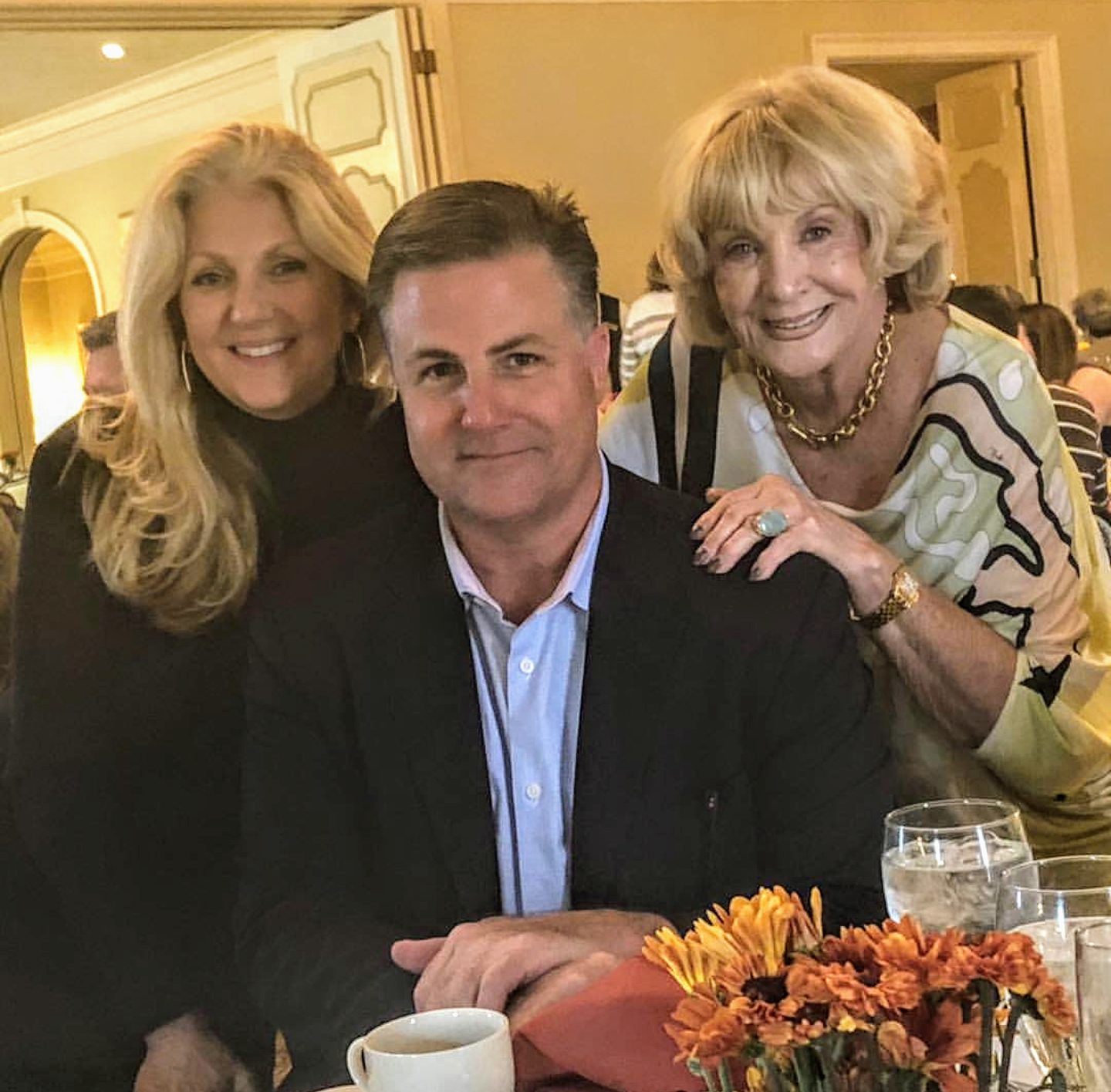
It is so fitting to have these two great women featured here together. Not only are they the two greatest women in my life, they are great friends with each other — a blessing I can’t say enough about. They say you try to “marry someone like your mother.” I’m not educated enough to expand on that here, but I can say: if finding Lovi in Houston back in 1996 had anything to do with my mother’s looks, heart, compassion, faith, and overall great spirit and character, then yes — I am living testimony to that theory. I am so undeserving of both of them, and so very thankful for having them in my life.

My dear mother met my father on the Baylor campus in 1960. The “May Queen” — she won that title in 1961 as a freshman from Memphis, Texas. She has been through great times and rough times, but one thing always held true: she has been, and remains, one incredible mother. Always at my father’s side through it all — the traveling-salesman years, the workaholic years growing the parts business, even the difficult campaigning and political days — she remained steadfastly committed to him and to family, all the while being the glue and the rock that held everything together. A mother of six children, five still with us today, and there wasn’t — and still isn’t — a thing she wouldn’t do for her children. She is simply the greatest.

Houston is special to me. It’s not only where I was born, but where I met my wife, Lovi. I’ve always joked that I met her in a honky-tonk — and it’s not wrong. I was briefly introduced to her one night at “Blanco’s,” listening to Gary P. Nunn, by a mutual friend. Somewhere between work and fishing Port O’Connor every chance I got, I finally managed to ask her out — inspired, interestingly, by a couple of fishing trips. On one, fishing with my father at 26, he said something like, “You know, Jeb, back in the day, if we were 26 and not married, people would’ve thought something was wrong with us…” On another, drifting Swan Lake in Copano Bay, I told a good friend, “Man, I gotta go on a date with somebody soon.” He said, “You know who you need to ask out? Lovi Loper!” I called her that night, back in Houston. I didn’t know it, but she was expecting the call — my fishing buddy’s wife had already tipped her off. A few days later I picked her up in my ’83 Land Cruiser and we joined other couples for a BYOB dinner at Collina’s Italian on Richmond Ave.

It was a relatively short courtship — engaged within months. My father mentioned that Uncle Leo had a diamond he’d recently traded for while buying guns from an estate. I had the stone mounted on a platinum band, sandwiched between two beautiful sapphires. We thought it helped set the fairly flawed diamond off a little better! I proposed to Lovi on the roughly three-mile walk around Memorial Park, and we married in February of 1997 at Perkins Chapel on the SMU campus, honeymooning in Cabo San Lucas after a pretty nice reception at the Mansion on Turtle Creek — where we stayed the night in “JR’s Suite.”

We spent five years in Houston, attending Second Baptist — Lovi managing the local Cole Haan store while I worked in oil & gas at The Andrews Group International. Our first son, Bobby, was born there, while we lived in a duplex on Nantucket near Briargrove and the Galleria. Before long we moved to Fort Worth: a newborn made being closer to family attractive, and Lovi, a TCU Horned Frog, was equally excited about getting back to Cowtown, where our second son, Chaz, would soon be born. Lovi has such a sweet spirit (most of the time ;) — and even though I was back in MY hometown, I soon realized she was much better known around Fort Worth. I was not so much Jeb Bradshaw as “Lovi’s husband”… and I’m OK with that. She is certainly my better half.

I’ll fast-forward to close with what led to starting Cogdell Kitchens with Lovi. While I’m an insurance executive by profession, I’ve had a few hobbies over the years that led to entrepreneurial ventures — most never accelerating past “hobby” mode, and one ending in a three-year trademark battle with a California clothier that we lost. Took the wind out of our sails. The chili blend was different. After a few taste tests with my wife and close friends, she said to me privately: “You have to do something with this. It’s that good — and if you DON’T, I’m going to run with it.” She had never been that excited about any of my little hobbies-turned-side-hustles — not the “YakLeash” kayak fishing accessories, not the “Fat Yabby” ghost-shrimp pumps, not even Laguna Costa lifestyle clothing. But she got VERY excited about the chili. I don’t know that I could have done this without her and the invaluable insight, intuition, and assistance she provides as my wife and business partner… so HERE WE GO!

“You have to do something with this. It’s that good — and if you don’t, I’m going to run with it.” — Lovi

Shop the dumps